Corrosion Protection & Surface Coating in Trailer Frames
Engineering overview of corrosion protection methods for semi trailer chassis — including shot blasting, zinc-rich primers, hot-dip galvanizing, and long-term surface durability testing.
Surface Engineering Material Protection
📅 Published on 2025-11-10 | ✍️ Semi Trailer News Technical Desk
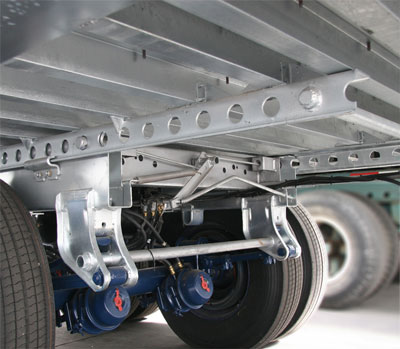
Image: Hot-dip galvanizing line for heavy trailer chassis components
🔹 The Challenge of Corrosion in Trailer Frames
Semi trailers operate in harsh conditions — exposed to rain, road salt, and UV radiation. Without proper coating systems, rust propagation can compromise structural integrity within a few years. Corrosion resistance is therefore a fundamental aspect of trailer engineering, especially for export and coastal operation markets.
⚙ Corrosion Mechanisms
- Electrochemical reaction: Iron oxidizes in the presence of oxygen and moisture.
- Galvanic corrosion: Occurs when dissimilar metals contact under an electrolyte (e.g., zinc + steel).
- Crevice corrosion: Common around bolted or welded joints where moisture is trapped.
🧱 Surface Preparation
Durable coating begins with proper substrate preparation. Shot blasting to Sa 2.5 (ISO 8501-1) is the industry standard for removing scale and contaminants. Surface roughness (Rz 40–80 µm) provides mechanical keying for primer adhesion.
🧴 Coating Systems Overview
| System | Coating Type | Average Durability |
|---|---|---|
| Single-layer Primer | Zinc-rich epoxy | 5–7 years |
| Duplex System | Epoxy + Polyurethane | 10–12 years |
| Hot-Dip Galvanizing | Zinc (70–120 µm) | 15–25 years |
| Powder Coating (Duplex) | Galvanized + Polyester powder | 20+ years |
💡 Protective Strategies
- Seal weld ends and avoid moisture traps in design stage.
- Use cavity wax or bitumen coating in internal box sections.
- Ensure drainage holes are present on all closed profiles.
- Inspect coating integrity annually — especially under kingpin and suspension brackets.
🔩 Testing & Quality Control
Coating performance is verified through salt spray testing (ASTM B117) and cyclic corrosion tests (ISO 20340). These accelerated methods replicate years of exposure in weeks, evaluating adhesion, blistering, and edge corrosion.
🏗 Industry Practice Example
European OEMs such as Kässbohrer employ full hot-dip galvanization for steel chassis components in their tipper and tank series. Their coating systems are certified under ISO 12944 C5-M for marine-grade corrosion resistance, ensuring long-term durability in aggressive environments.
🌊 Environmental & Sustainability Aspects
Modern coating facilities use low-VOC epoxy formulations and closed-loop water filtration. Galvanizing plants now recover >90% of zinc through continuous recycling, reducing environmental impact and production costs.
Conclusion:
Corrosion protection is both an engineering and economic factor in trailer manufacturing.
Advanced coating systems, proper surface design, and material choice extend product life cycles, lower maintenance costs, and preserve residual value — essential for modern fleet operators worldwide.