Chassis Fatigue under Dynamic Road Loads in Heavy-Duty Semi Trailers
Engineering analysis of fatigue behavior in trailer chassis under real-world road vibrations — covering stress cycles, design factors, testing, and material endurance improvement.
Fatigue Analysis Structural Durability
📅 Published on 2025-11-10 | ✍️ Semi Trailer News Engineering Desk
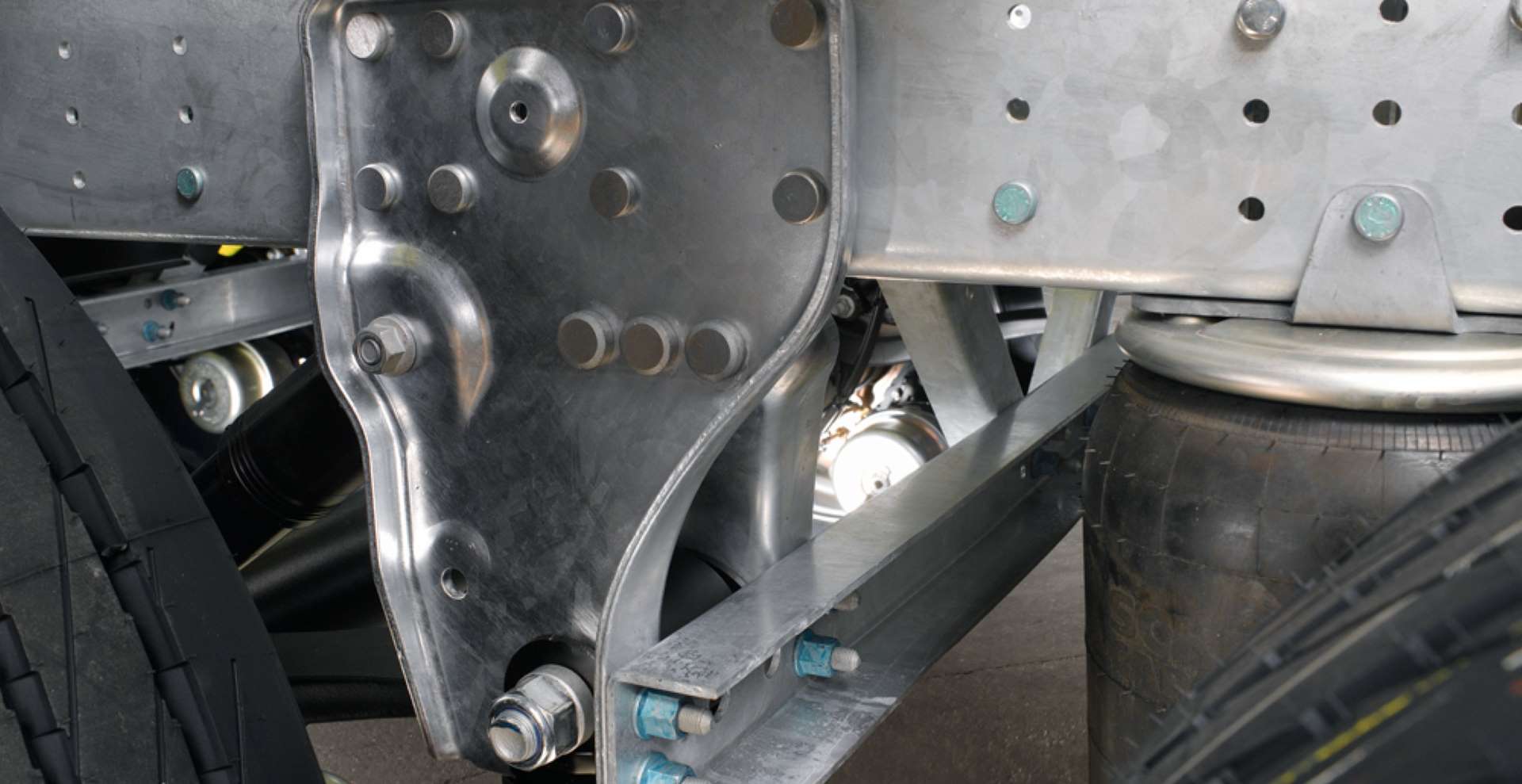
Image: Strain gauge measurement setup during dynamic road load test on a lowbed chassis
🔹 The Nature of Dynamic Fatigue
Unlike static overloading, fatigue damage accumulates from millions of small stress cycles caused by road irregularities, acceleration, braking, and cornering. These repetitive loads gradually weaken the structure — even when stresses are below the yield strength of steel.
⚙ Stress Cycle and Fatigue Life
Each bump or pothole generates a stress cycle. The relationship between stress amplitude (σa) and number of cycles to failure (Nf) is represented by the S–N curve of the material:
σa × Nfᵇ = C
For S355 steel, fatigue limit is typically around 180 MPa for 2×10⁶ cycles. Above this range, microcracks form near weld toes, bolt holes, and cross-member joints.
🧭 Critical Stress Zones
- Gooseneck–deck transition (moment concentration)
- Suspension brackets and spring hanger welds
- Kingpin plate weld perimeter
- Side beam–cross member intersection
📊 Test Methods for Fatigue Evaluation
| Test Type | Purpose | Duration |
|---|---|---|
| Road Simulation Bench | Replicates 1,000 km per hour of vibration | ~200 hours |
| Strain Gauge Measurement | Records real stress under operation | Field-based |
| FEA Fatigue Simulation | Predicts life expectancy using digital model | Design stage |
💡 Design Optimization Techniques
- Increase fillet radius at weld joints to reduce stress concentration.
- Use high-tensile steels (S700MC) with low notch sensitivity.
- Introduce longitudinal stiffeners along high-stress bottom flanges.
- Apply TIG dressing or laser peening at critical welds.
🏗 Industry Example
Manufacturers like Faymonville conduct full-scale fatigue testing equivalent to 1 million load cycles per trailer model. Such endurance validation ensures structural integrity even under harsh construction or mining routes.
🧾 Operational Guidelines
- Inspect weld seams and cross-members every 20,000 km.
- Avoid mixed loading (front-heavy cargo followed by tail-heavy cargo).
- Use torque-controlled tightening on suspension bolts to prevent micro-movement.
- Keep tires balanced — vibration magnifies fatigue stresses by up to 30%.
Conclusion:
Fatigue failure is silent but progressive.
A well-designed chassis, verified through simulation and endurance testing, can survive decades of service — provided maintenance practices align with its engineering limits.
In the end, durability is not just about material strength but about how consistently the trailer faces its real-world load spectrum.